
Hey everyone,
Most of us have probably experienced this, right? Or at least heard a ham friend complain about it. Picture this: You’ve saved up, done your research, compared models, and finally decided on that top-tier amateur radio you’ve been dreaming about for months, maybe years. Your heart’s pounding as you log onto your preferred dealer’s website or call them up. And then comes that moment… the dreaded “Out of Stock” message on the product page, or the apologetic voice of the salesperson on the phone: “Sorry, the waiting list is incredibly long, and the estimated delivery date… honestly, we don’t even know ourselves.”
That’s precisely when I found myself asking, “What on earth is going on?” Is this just my bad luck, or is it a widespread problem? Why has it become so incredibly difficult to get our hands on flagship models from giants like Icom, Kenwood, and Yaesu? With these questions swirling in my head, I rolled up my sleeves and decided to do a little research of my own.
And believe me, the picture that emerged was far more complex than I’d imagined. This wasn’t just a simple “production can’t keep up” situation; it was a “perfect storm” caused by multiple, major crises hitting all at once.
I followed the trail of this storm, focusing on one of the hardest-to-find models I’d been eyeing: the Yaesu FT-DX101. It was the one I was most curious about anyway. And here’s what I found, which I’m excited to share with all of you:
Just the Tip of the Iceberg: The Mysterious Journey of That Radio
First off, I have to say, like many of you, I initially thought these radios might have been completely discontinued. But the more I dug, the more I realized that wasn’t quite the case. For instance, I saw that major dealers, especially in the North American market, were quoting “late 2025 or even beyond” for the FT-DX101 series. That’s almost two years away… almost as if they’re expecting it to arrive via a time machine.
But here’s a really interesting twist: I noticed that some ham radio dealers in the UK were listing these very same radios as “in stock”! Some even had cashback offers accompanying them. This immediately told me that the product wasn’t entirely out of production, but that production was very limited, and Yaesu was likely prioritizing different markets with this restricted supply. This first discovery helped me realize that the issue was far more complex than just “production stopped.” But that was only the beginning of the story.
The First Big Wave: A Global Component Crisis That Brought the Industry to Its Knees
Modern amateur radios, especially those with the amazing SDR (Software-Defined Radio) technology we love, aren’t made with ordinary parts. They contain very specialized, high-performance electronic components. And unfortunately, in the last few years, the supply chain for these critical components has been hit by two of the biggest blows in history.
-
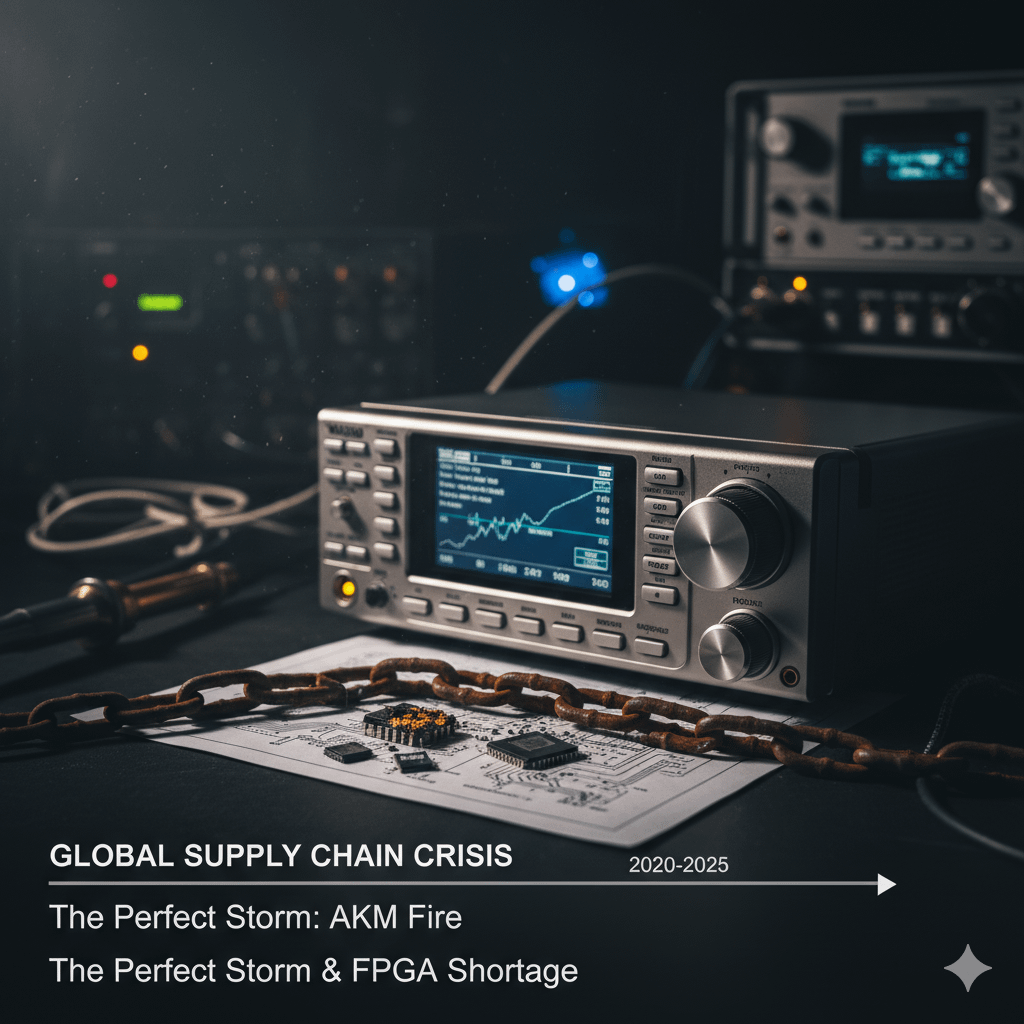
The AKM Fire: One Spark That Changed Everything In October 2020, a devastating fire broke out at the Asahi Kasei Microdevices (AKM) semiconductor factory in Nobeoka, Japan. It raged for 82 hours and almost completely destroyed the factory. This fire sent shockwaves not just through the ham radio world, but across the entire tech industry. Why? Because that factory was one of the world’s most important producers of high-quality Analog-to-Digital Converter (ADC) and Digital-to-Analog Converter (DAC) chips – essentially the heart of our SDR radios. Those critical parts that convert the radio’s “hearing” and “speaking” capabilities into digital signals…
My research confirmed that even Kenwood was severely impacted by this fire. Rumors circulated that models like the TS-890S and even the flagship TS-990S were on the verge of being discontinued due to the chip shortage, and some models were indeed pulled from production. The AKM fire was the first major break in the supply chain. No parts, no radios – it was that simple.
-
The FPGA Shortage: When Digital Brains Went to War Another crucial component is the FPGA (Field-Programmable Gate Array). These chips act like the “brain” of our radios, handling complex tasks like signal processing and filtering. But here’s the kicker: in recent years, massive industries like 5G technology, artificial intelligence, and colossal data centers have exploded. These sectors created such an enormous demand for FPGAs that our radio manufacturers found themselves competing with these tech giants for the same components. And as you can imagine, the purchasing power of radio manufacturers pales in comparison to that of Google, Amazon, or Samsung.
The result? Delivery times for FPGAs stretched for months, even over a year, along with soaring prices. So, even if you managed to find parts after the AKM fire, this time you couldn’t find the FPGA to build the radio’s brain. This situation was the second major blow, creating a chronic bottleneck that significantly slowed down production.
The Second Big Wave: Hidden Production Challenges and the Cost of Quality Control
Of course, it wouldn’t be fair to blame everything on the global shortage. There’s another, more subtle side to the coin that involves the manufacturers themselves. In my research, I discovered that the Yaesu FT-DX101 series experienced significant “teething problems” in its early days after launch. There were even some hardware recalls. Users on forums reported serious manufacturing defects like “ALC overshoot” (issues with the radio’s power output control system), “antenna tuner failures,” and even “loose screws” inside brand new units. Even worse, some had to send their radios in for service multiple times due to critical manufacturing flaws like “cold solder joints on the main board.”
This whole situation showed me just how incredibly challenging it is to mass-produce such a complex, high-tech radio flawlessly. When not every unit coming off the production line is perfect, that means a low production yield. And consider this: if you already have a limited supply of parts, and then you’re making mistakes putting those parts together, the crisis only intensifies. So, even if the parts were available, there might have been a struggle with the knowledge and processes to assemble them perfectly.
Why Was Icom Different? The Significance of an Exception
Amidst all this gloomy information, one detail stood out to me and made me think the most: the Icom IC-7610. This model is the FT-DX101’s biggest competitor in the market, and I found that it was consistently listed as “in stock” and “available for immediate shipment” at major dealers!
This strongly suggests that Icom either managed its supply chain much more successfully, stocked critical components well before the fire and shortages began, or designed its radios from the outset to be less dependent on the specific parts affected by the crisis, perhaps using alternative component sources. Icom’s consistent supply performance proved to me that the crisis, while severe, was manageable, and not every manufacturer navigated this storm in the same way. It seems some companies were simply more resilient in their supply chain.
What Awaits Us in the Future? My Own Predictions
This “perfect storm” we’ve experienced gives us some important clues about the future of our ham radio hobby:
-
Longer Product Lifecycles: We might not see new models launched every year anymore. Manufacturers might have to keep existing models on the market for longer. (Which, for me, is fine, as long as the quality is there!)
-
A Shift in Design Priorities: When designing new radios, engineers might start considering not just “peak performance” but also “easily available and multi-sourced components.” So, we might see more risk-averse designs.
-
Prices Will Continue to Rise: Unfortunately, both the cost of scarce components and the R&D expenses incurred to overcome these crises will likely continue to be reflected in the final prices of radios. (I just hope they don’t compromise on quality.)
In conclusion, friends, that dream radio being out of stock for months or even years was much, much more than a simple inventory management problem. It was the result of a complex equation formed by a global fire, the competition of giant industries, and the very limits of manufacturing technology, all coming together.
As amateur radio operators, I think we’ll need to be a bit more patient. Let’s appreciate the radios we have, and most importantly, let’s keep the spirit of this wonderful hobby alive – the spirit of camaraderie and communication. Who knows, perhaps these crises will push us to find more creative and alternative solutions, bringing a fresh breath of air to our beloved hobby.
I hope my research has been as enlightening for you as it was for me. I’m eager to hear your thoughts and your own experiences on this!
73 DE TA2LE – HALUK